What is a PDF file? A practical guide for everyday work
This guide was prepared by the PDFMaple team in Ottawa for readers who need a plain-language explanation of what PDFs are, when they are the right format, and how they fit into everyday document workflows.
- Why PDFs are everywhere
- Common PDF tasks (and the tools that solve them)
- A simple, reliable PDF workflow
- Real-world use cases for what is a PDF file
- Expert tips that save rework
- Is it safe to upload your files?
- Online tool vs desktop software — which should you use?
- Frequently asked questions
- What to do next
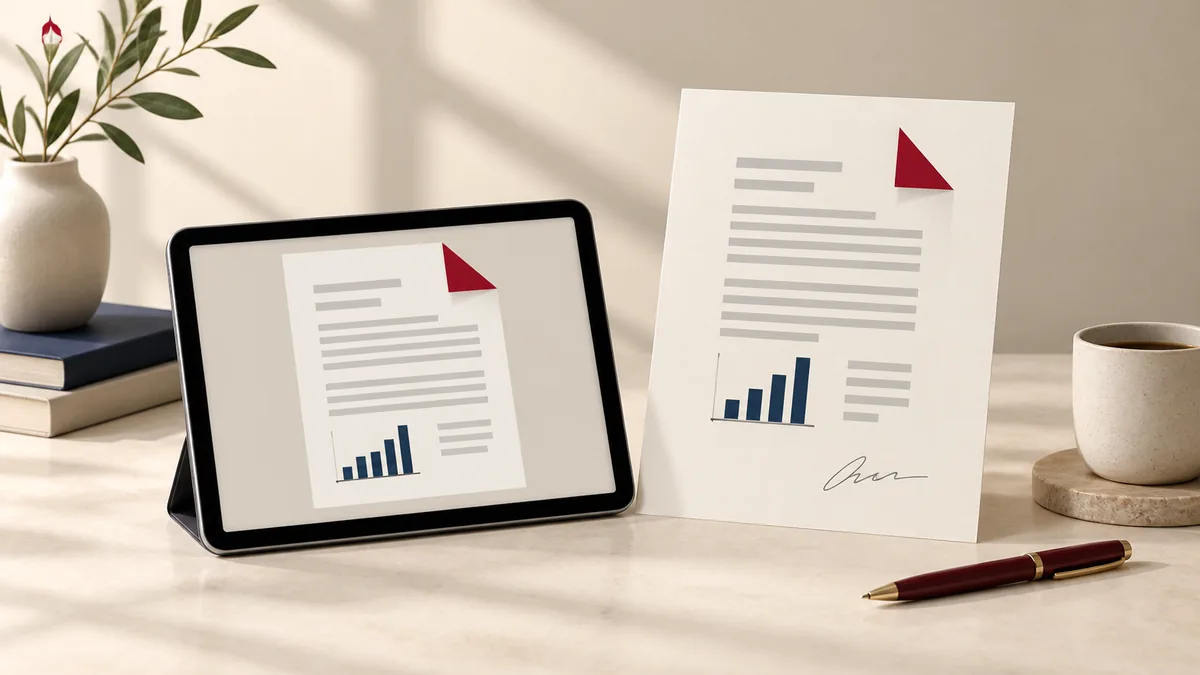
A PDF is the document format people reach for when layout has to hold still. It is what you use when a file needs to look the same on a recruiter’s laptop, a client’s phone, a school portal, or an office printer.
That does not make PDF the authoring format for every task. In most workflows, the PDF is the handoff copy, while Word, Excel, PowerPoint, design files, or scanned originals remain the working source. Once that distinction clicks, most PDF decisions get much easier.
Why PDFs are everywhere
- Consistency: PDF pages keep the same layout and spacing.
- Printing: PDF is the default format for reliable printing.
- Sharing: PDFs open in browsers and work well as email attachments.
- Security: PDFs can be password-protected and signed.
- Archiving: Standards like PDF/A help with long-term storage.
Common PDF tasks (and the tools that solve them)
Here are the tasks we see most often—plus the PDFMaple tool that matches the job:
- Merge PDF — combine multiple PDFs into one.
- Split PDF or Extract pages — keep only the pages you need.
- Compress PDF — reduce size for email and web uploads.
- PDF to Word — reuse or edit text-based documents.
- Protect PDF, Sign PDF, and Redact PDF — secure and approve documents before sharing.
A simple, reliable PDF workflow
If you’re not sure which tool to use, this sequence works for most documents:
- Organize first: remove pages you don’t need or extract only the pages you’ll share.
- Improve readability: rotate sideways pages and crop big margins.
- Optimize size: compress for email/web.
- Secure before sending: watermark drafts, redact sensitive info, then password-protect if needed.
Quick start: Open Merge PDF or Compress PDF—those two cover a surprising number of “I just need to…” PDF moments.
Real-world use cases for what is a PDF file
Understanding pdf files is rarely about the feature alone. It is about getting to a clearer mental model for when PDF is the right format and what to do with one next.
Business and operations
Teams rely on PDFs because they travel well across devices and preserve layout in reports, invoices, and approvals. That gives the team a more stable handoff format for approvals, review, and storage.
Student projects
Students encounter PDFs everywhere from lecture notes to assignment submissions and quickly learn that stable layout matters. That helps students choose the format that is least likely to create surprises when they submit or print.
Legal and admin work
Administrative workflows depend on PDFs because forms, notices, and records need predictable viewing and printing. That keeps records more predictable because the file format matches the way the document will actually be handled.
Freelancer delivery
Freelancers prefer PDFs for proposals and client-facing documents when they want the design to hold together outside the source app. That makes client-facing files easier to review because the format is chosen for handoff rather than ongoing editing.
Personal paperwork
People run into PDFs in banking, government, housing, and healthcare because the format is built for dependable sharing. That usually means fewer resend requests because the document is in a format built for sharing and recordkeeping.
Expert tips that save rework
The mistake is usually not misunderstanding a feature name; it is picking the wrong format or workflow for the job. With what is a pdf file? a practical guide for everyday work, the useful check is whether the file is ready for sharing, editing, printing, or archiving—the outcome you actually need.
- Think of PDF as the handoff format: In many workflows, the editable file lives in Word, Excel, or another app and the PDF is the stable copy that moves to the next person.
- Separate viewing from editing needs: A PDF is excellent for reliable presentation, but that does not always mean it is the best place to make deep edits.
- Know the common follow-up tasks: Once you understand merge, split, compress, convert, sign, and protect, PDFs stop feeling mysterious and start feeling manageable.
- Use the source file when real editing matters: If you still have the original DOCX or XLSX, that may be the best place to revise content. The PDF is often for the final-stage workflow.
- Match the tool to the problem: A large PDF does not need the same fix as a protected PDF or a scanned PDF. Naming the real problem is half the solution.
Use the finished copy the way a real recipient would—open it, scroll it, maybe upload it—before you assume the workflow is done. That final reality check is where most avoidable issues are caught.
Is it safe to upload your files?
Not every PDF task requires an upload, but many convenient PDF workflows do. When you use an online tool, the practical things to check are simple: the transfer should run over HTTPS/TLS, uploaded files should be deleted automatically after processing, and the service should explain clearly that it does not read, sell, or store file contents as a document library.
That is the standard PDFMaple aims to meet. If you are handling highly regulated material, or if policy requires fully local processing, desktop software may still be the better choice. For routine document tasks, though, a browser workflow can be reasonable as long as the privacy handling is explicit and the service publishes the details in its Privacy Policy.
Online tool vs desktop software — which should you use?
Most people do not need a full desktop PDF suite just to understand or handle everyday PDFs. Browser tools are enough for the common jobs that follow a basic PDF question: merge a few files, compress a scan, convert a document, or secure a final copy. Acrobat becomes more useful when the work turns into full document production, advanced review, accessibility fixes, or policy-heavy offline handling.
Adobe Acrobat still makes more sense when you need full publishing, accessibility remediation, and advanced document production, or when the files must stay in a tightly managed offline environment. If the job is occasional and practical, online is usually enough; if it is repetitive and highly controlled, desktop has the edge.
- Best for one-off document chores
- Practical on mobile or remote setups
- No extra software to maintain
- Good when speed matters more than deep control
- Large recurring jobs
- Deeper correction and document inspection
- Offline-only environments
- Teams that need standardized desktop procedures
Frequently asked questions
What does PDF stand for?
PDF stands for Portable Document Format. The important part is not the acronym itself but the idea behind it: a PDF is meant to preserve layout so the document looks consistent across devices, browsers, and printers. That is why PDFs are so common for reports, forms, contracts, invoices, and final handoff copies.
Are PDFs supposed to be edited?
Usually not as the first choice. In most workflows, the editable source stays in Word, Excel, PowerPoint, or another authoring tool, while the PDF is the stable version that gets shared or archived. You can edit or convert some PDFs, but heavy revision is usually easier in the original source file if you still have it.
What is the difference between a text PDF and a scanned PDF?
A text PDF contains selectable text and often comes from an export out of another application. A scanned PDF behaves more like a page image, which is why copy-paste, search, and conversion results are usually weaker. Knowing that difference helps you choose the right next step—compress, convert, redact, sign, or simply keep the file as a final record.
Why do PDFs stay consistent across different devices?
Because the format is built around fixed page presentation rather than live document editing. Fonts, spacing, page breaks, and layout instructions are packaged so the document travels more predictably than a raw office file. That consistency is the main reason PDFs are used for final review, printing, and formal submission.
Why is my PDF so large?
Large PDFs are usually caused by scans, high-resolution images, embedded fonts, or extra pages that no one actually needs. A PDF can also grow as it moves through different apps or gets re-exported several times. When that happens, the right fix is usually to compress the file, remove unneeded pages, or go back to the cleaner source document instead of guessing.
When should I use PDF/A instead of a normal PDF?
Use PDF/A when the goal is long-term archiving and future readability, not just everyday sharing. PDF/A is stricter about self-contained document data such as fonts and color information so the file is more dependable years later. For routine sending, review, and signatures, a regular PDF is often enough; for records retention, PDF/A can be the better choice.
What to do next
Once this part is done, the workflow normally shifts to choosing the right tool for the actual task: convert, edit, sign, protect, or archive. Use the links below if that is what you need next.
Further reading
For background on the format, read Adobe's introduction to PDF. For long-term preservation, see the Library of Congress PDF/A format description.