Excel to PDF: fit your sheet on one page
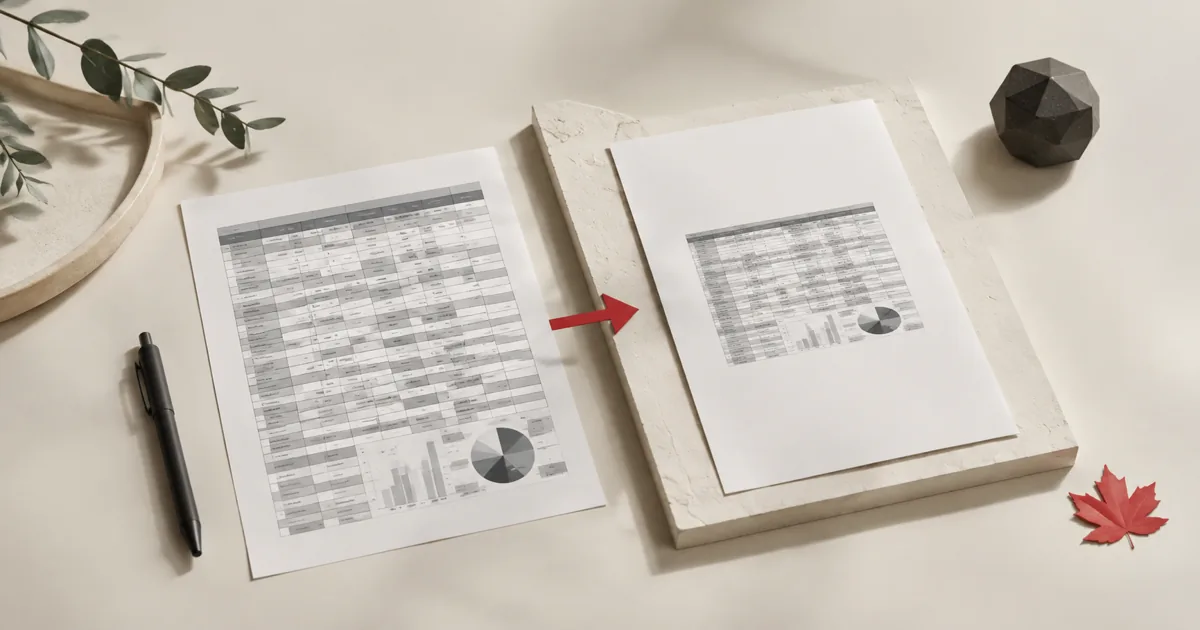
If your spreadsheet prints across multiple pages, the PDF can become hard to read—and frustrating to share. The fix is usually print setup (scaling, print area, orientation) before conversion.
This guide shows how to prep your file in Excel, then convert it using Excel to PDF.
When one-page PDFs matter
- Invoices, quotes, and one-page summaries
- Reports that must print cleanly for signatures
- Spreadsheets being sent to clients who don’t use Excel
Step-by-step: prep then convert
- Set the print area: select the cells you want, then set Print Area in Excel.
- Choose orientation: Landscape often fits wide tables better.
- Scale to fit: set scaling to “Fit all columns on one page” (or 1 page wide).
- Check margins: narrow margins can reclaim a lot of space.
- Save the spreadsheet.
- Open Excel to PDF and upload the updated file.
- Download the PDF and review it at 100% zoom.
Common layout fixes
1) Hide helper columns (then export)
If you have helper columns, hide them before exporting. The PDF should show only what the reader needs.
2) Adjust column widths before scaling
Over-wide columns force Excel to shrink everything. Reduce widths, wrap text, and shorten headers where possible.
3) Keep text readable
“Fit to one page” can make small fonts tiny. If readability drops, consider making it “1 page wide” but multiple pages tall.
4) Compress for email sharing
If the resulting PDF is too large to send, use Compress PDF or follow this email compression guide.
Real-world use cases for fitting a spreadsheet onto one page
Most problems in this workflow appear after the file leaves your screen. A good outcome here is a one-page or intentionally paginated sheet that does not clip key columns or totals.
Business and operations
Teams convert sheets to PDF when they need a clean report for leadership, vendors, or clients rather than an editable workbook. That matters because the recipient gets a format they can open and review without asking for the source app or original file.
Student projects
Students use Excel-to-PDF workflows for grade trackers, lab tables, schedules, or data summaries that need predictable page breaks. That is useful when the portal or reviewer expects a specific format and layout has to stay predictable.
Legal and admin work
Admin staff often archive schedules, logs, or tabular records as PDFs so the layout stays fixed in review or storage. That helps preserve a cleaner handoff because the document arrives in a format built for stable viewing and printing.
Freelancer delivery
Freelancers may send pricing tables, project plans, or budget sheets as PDFs when the recipient should review rather than edit the workbook. That gives clients a version they can read quickly without accidentally editing the working file.
Personal paperwork
People convert household budgets, mileage logs, or payment schedules into PDFs for email, print, or application portals. That turns loose images or office files into one clearer document that is easier to upload, print, or store.
Expert tips that save rework
Conversion problems rarely come from the click itself. With excel to pdf: fit your sheet on one page, the real risk is source-file quirks, print settings, or layout drift that no one notices until the output is already shared.
- Set the print area before conversion: Excel will happily export more than you intend if the print area is loose. Define the section you actually want the PDF to show.
- Check scaling on paper-sized layouts: A spreadsheet that fits on one PDF page can still be unreadable if the text becomes too small. Balance page count against legibility.
- Mind hidden rows and columns: If a workbook depends on hidden data or grouped sections, confirm that the PDF shows exactly what you mean to share. Excel-specific structure can surprise you at export time.
- Use landscape when the data is wide: Do not force a wide table into portrait just to keep a conventional page shape. Readability matters more than tradition.
- Review repeated headers and totals: Long sheets should still make sense on page two and page three. Make sure key labels and totals remain easy to interpret in the final PDF.
Keep the original nearby, name the converted output clearly, and compare the pages most likely to drift before you forward it. That small habit prevents layout surprises from turning into a resend.
Is it safe to upload your files?
With converting Excel to PDF, most users are really asking whether the file is exposed during upload and whether the service hangs on to the contents afterward. PDFMaple handles the transfer over HTTPS/TLS, which protects the upload and download while the job is being completed. That is the practical baseline people want when the documents include things like budgets, dashboards, invoice summaries, staffing sheets, and printable tables. This matters even more in fit to one page cases, where small workflow mistakes are easier to miss.
The files are intended to be removed automatically after processing, and PDFMaple does not read, sell, or keep the contents as a standing document library. For the full policy wording and limits, see the Privacy Policy. That matters most for files such as budgets, dashboards, invoice summaries, staffing sheets, and printable tables.
Online tool vs desktop software — which should you use?
For most one-off jobs, the browser is the fastest path because the file can be fixed and downloaded without a longer software setup cycle. That matters most when you are on a borrowed machine, a phone, or a laptop that does not have Acrobat installed. For converting Excel to PDF, that usually means an online tool is enough when the task is occasional and deadline-driven. That is especially true when the job is fit to one page rather than a broad recurring workflow.
The desktop route is stronger when you need advanced page layout control, repeated reporting jobs, and offline workbook handling. For routine document chores, though, the lighter online path is often the more sensible choice because it gets you to the output faster.
- One task, one result, no install
- Useful on shared or borrowed devices
- Quick enough for phone and tablet work
- Good when the file just needs to move forward
- Large recurring jobs
- Deeper correction and document inspection
- Offline-only environments
- Teams that need standardized desktop procedures
Frequently asked questions
Does the converter automatically fit everything on one page?
Conversion follows your spreadsheet’s layout. For best results, set print area and scaling in Excel before uploading. Open the converted output and compare the pages most likely to drift—tables, slide layouts, page breaks, or image-heavy sections—before you rely on it.
Why does my PDF text look tiny?
Aggressive scaling shrinks fonts. Try “1 page wide” instead of “1 page total,” or simplify the sheet (hide columns, shorten headers). Open the converted output and compare the pages most likely to drift—tables, slide layouts, page breaks, or image-heavy sections—before you rely on it.
What about very wide dashboards?
Export in landscape and use “fit all columns on one page.” If it still becomes too small, export multiple pages or separate sections. Open the converted output and compare the pages most likely to drift—tables, slide layouts, page breaks, or image-heavy sections—before you rely on it.
Can I merge multiple spreadsheet PDFs?
Yes—convert each sheet to PDF, then combine them with Merge PDF . Open the converted output and compare the pages most likely to drift—tables, slide layouts, page breaks, or image-heavy sections—before you rely on it.
Why does an Excel PDF sometimes break across awkward pages?
Because spreadsheet layouts were not always designed with paper dimensions in mind. Column count, row height, margins, and print scaling all affect the PDF result. A few print-oriented adjustments in the sheet usually make a bigger difference than the conversion itself.
How do I fit an Excel sheet on one page without making it unreadable?
Start by narrowing margins, switching to landscape if needed, and checking whether every column truly belongs on the output. If the text becomes too tiny, it is better to let the PDF use more than one page than to force an unusable one-page export. Readability has to win.
What to do next
After converting Excel to PDF, the next step is usually circulating the report, locking it down, or archiving a final snapshot. The links below cover the most common follow-up moves for this workflow.